
Mold Month: Mold Prevention in Naples FL and What Owners Actually Walk Into in October

Mold Month: Mold Prevention in Naples FL and What Owners Actually Walk Into in October
In this industry we call October Mold Month.
It isn’t an official term and you won’t find it in a textbook. It’s just what everyone who does this work in Southwest Florida calls the stretch when homeowners come back, open a door that’s been closed since May, and find out what five months of Florida summer did to a house nobody was in.
We get more first-time client calls in October than any other month of the year. Almost none of them are calling because they read an article about humidity. They’re calling from a driveway, or a hotel room, or a hallway, having just walked into something.
That’s why mold prevention in Naples FL matters for seasonal homeowners who leave their properties closed for months.
A note on language before we go further. We say microbial growth, not mold. It isn’t a euphemism. Mold is one category of what actually grows in a warm, still, humid house, and the word sends people straight to a worst-case image and a claim form before anyone has looked at the wall. Microbial growth is the accurate term for what we find and what we’re trying to prevent, and it covers the early stages that are still easy to deal with. We use it because it is correct, and because the earlier we can have this conversation with a homeowner, the smaller the problem is.
What it actually looks like
It’s rarely dramatic. Most people expect a black bloom across a wall. That happens, but it’s the late stage.
What people usually find first is a smell. Not a bad smell exactly, more like the house is holding onto something. It’s in the closets, in the linens, in the drawers of the guest room nobody opened.
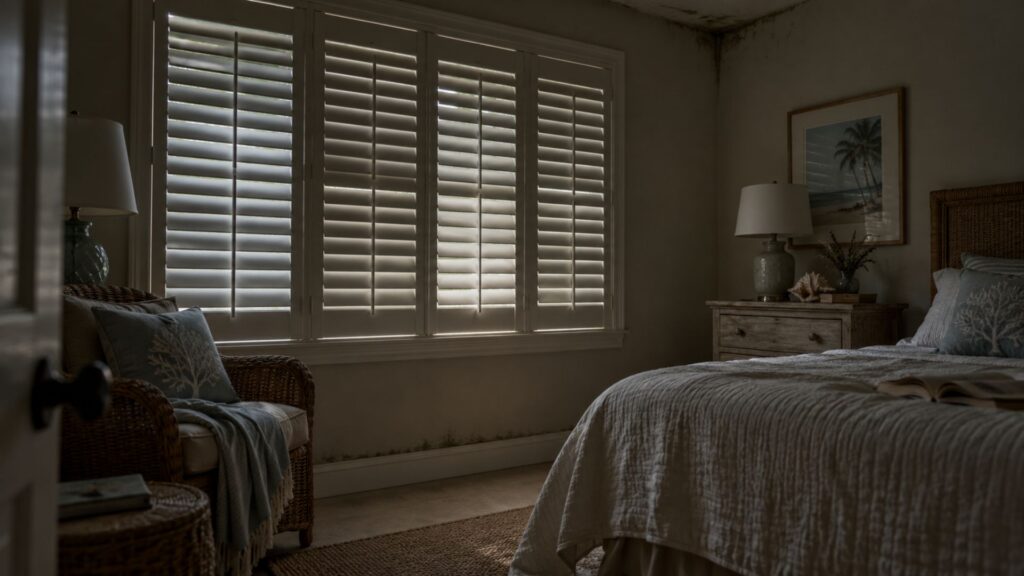
Then they start noticing. A dark line along the bottom of the baseboard in the room farthest from the AC return. Leather furniture that’s gone slightly tacky. A spot on the ceiling of the primary closet. Books that have curled. A wooden door that no longer closes cleanly because it swelled. Fine dark speckling on the ceiling of the guest bath, on the wall behind a headboard, in the corner of the laundry room.
These are the kinds of early warning signs associated with mold in seasonal homes that remain closed during Florida’s humid summer months.
None of that happened in October. It happened in July, and nobody was there to see it.
The numbers this actually comes down to
We hold interior relative humidity in the homes we watch at around 50%.
Above 55%, a closed home is already in risky territory.
At 60% and higher, microbial growth can begin blooming within 72 hours.
That last figure is the one worth sitting with, because it reframes the whole problem. Three days. Not a slow seasonal decline you might catch on a monthly drive-by, but a window that opens and closes inside a single week.
Which means the question is not really whether someone visits your home. It’s how many days can pass between visits before a failure that started on a Tuesday has had time to become something you can see. That is the entire argument for visit frequency, and it is why a humidity reading logged at every visit matters more than almost anything else we do. A number that has drifted from 49 to 54 over three visits is a conversation. A wall you can see it on is a project.
This is why humidity control in vacant homes matters. Small changes in moisture levels can become much bigger problems when nobody is there to notice them.
Why the closed house is the problem, not the weather
Everyone here understands humidity. What catches people out is what happens to humidity in a house with nobody in it.
This is one of the main reasons mold in vacant homes Florida becomes a concern for homeowners returning after the summer.
An occupied home is constantly being ventilated by accident. Doors open, showers run and exhaust fans pull, laundry gets done, the AC cycles hard because people are adjusting it. A closed home has none of that. The AC runs on a vacancy setting, which cools but doesn’t necessarily dehumidify well, and it cycles less often, which means less moisture gets pulled out of the air.
Then something small goes wrong. A condensate drain line partially clogs. A supply vent gets closed in a spare room. A dehumidifier’s drain hose kinks. A slider seal that always leaked a little starts leaking a little more. The AC compressor fails in the middle of August and the house sits at ambient humidity for two weeks.
Any one of those in an occupied home is an annoyance you notice in a day. In a closed home it’s a condition that runs for weeks, and it only takes three days of it to start.
For homeowners, mold in vacant homes Florida is often the result of moisture problems that went unnoticed while the property was closed.
The cost, and the part people don’t budget for
The remediation cost is only part of it. Depending on how far it went, you may also be looking at drywall and baseboard replacement, repainting, replacing soft goods that can’t be saved, HVAC duct cleaning or replacement, and testing before and after.
Then there’s the part nobody plans for: you can’t live in the house while it happens. Remediation is not a weekend. Families come down for their season and spend the first several weeks of it in a rental, managing contractors, in the exact months they came here to enjoy.
And there’s insurance. Coverage for this in Florida policies is frequently limited, capped, or excluded depending on the cause, and whether a claim is covered often turns on whether the underlying water event was sudden or gradual. A slow failure over five months is, by definition, gradual. That’s a conversation with your carrier and not with us, but it’s worth having before you need to have it.
What would have caught it
Not luck. Just someone in the house on a schedule, looking at the same things every time.
Interior humidity read and logged at every visit, so a drift from 49 to 54 is visible as a trend rather than as a surprise. AC verified as running and actually cooling and dehumidifying, not merely powered on. Condensate lines checked and treated. Every room entered, including the ones with nothing in them, because the guest room at the far end of the return path is usually where it starts. Under every sink. Behind the water heater. Closets opened. Time and date stamped photos of the same locations each visit, so month five can be compared to month one.
That’s it. It isn’t complicated work and it isn’t glamorous. Its entire value is that it’s done consistently, by someone who has seen enough closed houses to know what an early sign looks like.
That’s where regular Naples home watch services become valuable. Consistent visits help identify changes before they turn into expensive problems.
And that consistency is what makes mold prevention in Naples FL possible for homeowners who spend part of the year away.
If you’re standing in it right now
A few things, in order.
Don’t run fans at it. Moving air around an affected space can spread spores through the house.
Don’t start pulling things apart before it’s been looked at. What gets removed and how it gets contained matters, and it also matters for any claim.
Get the moisture source identified before anything gets remediated. Remediation without fixing the cause buys you a season, not a solution.
Call your insurer early, even if you suspect it won’t be covered, because reporting timelines can affect coverage.
And if you want, call us. We can be at the house, look at it with you, and put you in front of the right vendor rather than the first one who answers. In October those vendors book quickly, and where you sit in that queue is worth something.
And if you’re reading this from up north
Your house is closed right now. If nobody has been inside it since spring, the useful thing is not to worry about it. It’s to have someone go look, this week, and tell you what the humidity reads.
We’ll do that walkthrough and quote your home with no obligation. Most of the time the answer is that the house is fine and the number is where it should be. That’s a good phone call to get.
Book a Free Consultation Today!
With no strings attached, we can meet with you and quote your home for our home watch and concierge services.
Call us today! We look forward to serving you.


